Carat in jewelry: weight of stones and purity of gold
Introduction: what is a carat?
The world of jewelry is full of specific terms, and one of the most important is undoubtedly the carat. The carat has a different meaning depending on whether it applies to a gemstone or a precious metal like gold. Let's discover together what lies behind this essential term.
Origin of the word
Carat origin: Did you know that the term "carat" comes from nature? It originates from the carob tree, a Mediterranean shrub whose seeds are known for their consistent weight. In the past, these seeds were used to measure gold during trade. They gave their name to the unit we know today.
Carat for gemstones
In jewelry, the carat measures the weight of a gemstone. This extremely precise measurement is done using scales sensitive to the hundredth of a gram, in a stable and vibration-free environment. The carat is an essential criterion for determining a stone's value, as its weight directly influences its price.

Importance of carat
For gemologists, experts in gemstones, the carat is a fundamental element. They use it to assess the quality of stones and negotiate their price with suppliers. The carat is also one of the famous 4C used to classify diamonds, along with color, clarity, and cut.
Example:
Let's take the example of two identical rings, each set with the same gemstone but of different weights: 0.5 and 0.8 carat.
Despite a minimal weight difference (0.06 grams or 0.3 carat), the price can double! This perfectly illustrates the impact of carat on a stone's value.
Key points
The carat for gemstones is noted as "carat" or abbreviated "ct". Remember: 1 carat equals 0.20 grams.
 |
 |
|
Women's Elisa ring 18-carat rose gold
|
Women's Santorin ring 18-carat yellow gold
|
The weight of a diamond: understanding carat and its impact on price
Definition of carat for diamonds
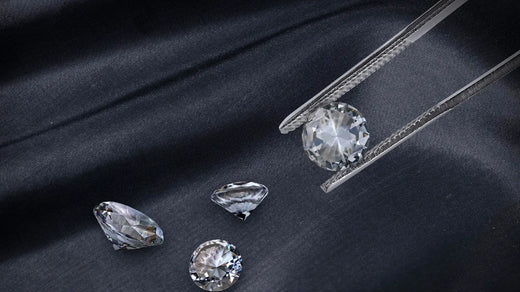
Carat is the unit of measurement used to determine the weight of a diamond. One carat equals 0.20 grams. Contrary to what one might think, carat does not indicate the size of the diamond, but its mass. A one-carat diamond can therefore appear larger or smaller depending on its cut and proportions.
Diamond price: the influence of carat
Carat is an essential criterion in the price of a diamond. The higher the carat, the rarer and therefore more expensive the diamond.
However, the value of a diamond does not increase linearly with its weight. A one-carat diamond is worth more than two half-carat diamonds, even if they have the same total weight. The price per gram of diamond therefore increases exponentially with carat.
Value of a 1 carat diamond
It is impossible to give an exact value for a one-carat diamond without more information. The price of a diamond, even with the same carat, can vary significantly depending on several factors:
The 4Cs:
- Color: The more colorless a diamond is, the rarer and more expensive it is. The color scale ranges from D (colorless) to Z (slightly yellow).
- Clarity: The presence of inclusions (internal imperfections) or blemishes (external imperfections) affects the clarity and price of the diamond. The fewer inclusions a diamond has, the more valuable it is.
- Cut: The quality of the cut is crucial. An excellent cut maximizes the diamond's brilliance.
- Carat (weight): As we have seen, weight strongly influences the price of the diamond.
Other factors:
- Fluorescence: The presence of fluorescence (reaction to ultraviolet light) can influence the price, either positively or negatively depending on the case.
- Shape: The shape of the cut (round, princess, pear...) affects the brilliance and therefore the price.
- Certificate: A diamond accompanied by a certificate from a reputable gemological laboratory (GIA, HRD) will have a higher value.
- Supply and demand: Like any precious good, the price of diamonds is influenced by the market.
In summary:
Assigning a value to a one-carat diamond requires a thorough analysis of its characteristics. Don’t hesitate to contact a jewelry professional for an accurate appraisal.
 |
 |
|
Volga Necklace 18 Carat Yellow Gold
|
Volga Earrings in 18 Carat Yellow Gold
|
More than jewelry: decoding the price of gold and diamonds
Take the example of a rose gold engagement ring set with a cut diamond. The price of this jewelry will depend on several factors. For gold, the purity level is expressed in carats. 14 carat gold will be less expensive than 24 carat gold, the latter being pure gold.
The price of a diamond depends on its weight in carats, equivalent to 0.2 grams. The higher the carat, the more expensive the diamond will be. Other criteria, such as color, clarity, and cut of the diamond, will also influence its price per carat.
Let’s not forget that making a ring and transforming raw diamonds into sparkling jewelry is expensive. Different elements like white gold, rose gold, and diamonds affect the value of a piece of jewelry.
Carat for gold
The carat for gold does not measure weight, but the purity of the alloy. It indicates the amount of pure gold in the alloy. Unlike stones, carat is used for gold. It is also called "fineness" or "thousandth fineness."
Different gold grades
- 24 carat gold (999 thousandths): 99.99% pure gold. Too malleable for jewelry, it is rarely used.
- 18 carat gold (750 thousandths): Alloy made of 75% pure gold and 25% other metals. It is the most used gold in jewelry, offering an excellent balance between durability and quality.
- 14 carat gold (585 thousandths): Less precious than 18 carat gold, it contains 58.5% pure gold.
In summary, the higher the carat number, the greater the proportion of pure gold in the alloy.
Bajoia's choice: 18 Carat gold
At Bajoia, we favor 18 carat gold for its exceptional strength and durability. This alloy, favored by the greatest jewelry houses, guarantees jewelry that withstands the test of time.
Check out our complete Gold guide to discover all its secrets.
The hallmark: guarantor of quality
Gone are the days when people bit into gold coins to check their authenticity! Today, it is the hallmark that certifies the quality of the precious metal. Customs stamp a hallmark on gold or platinum jewelry over 3 grams. This guarantees the quality of the precious metal.
Different hallmarks
The fineness hallmark, usually located on the outside of the ring, indicates the gold fineness (e.g., 750 for 18 carats). A second hallmark, called the "master’s mark," identifies the manufacturing workshop.
In summary
Two small hallmarks on your jewelry? Don’t worry! These are official marks that guarantee the quality of your precious metal.
Learn to identify the origin and quality of your gold and silver jewelry by consulting our Hallmark guide.
 |
 |
|
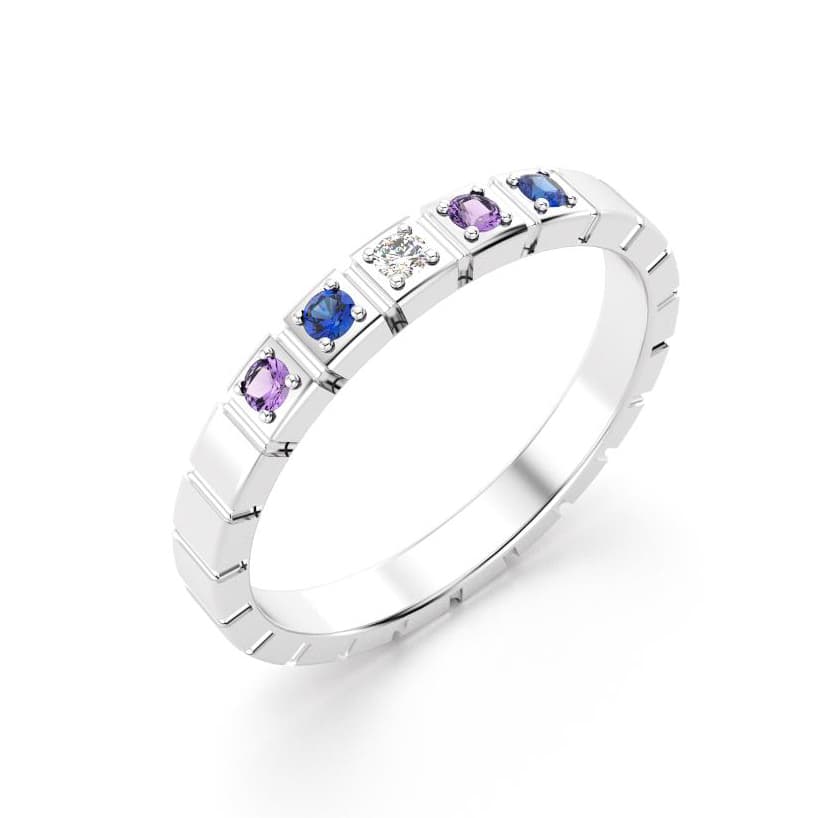
Women's Brick Ring 18 carat White Gold
|
Byzance Bracelet 18 carat White Gold
|
Frequently asked questions
Is one carat of diamond equivalent to one carat of colored stone?
Theoretically yes, because 1 carat = 0.20 grams for all stones. However, density varies from one stone to another. A diamond will have a different volume than a sapphire for the same weight.
From what weight are diamonds certified?
All our diamonds over 0.3 carat come with a certificate. This certificate proves they are genuine and details their characteristics.
How much does one carat weigh?
One carat weighs exactly 0.2 grams (a gram being a unit of weight).
Conclusion
Thus, choosing a gold and diamond piece of jewelry is much more than selecting a simple accessory. It means understanding a historical heritage, ancestral craftsmanship, and decoding a language of carats and purity. Ask our experts your questions to choose the perfect piece of jewelry that matches your tastes and budget. They will be happy to guide you.